

CLMTexfinity now offers S.threadscan in Europe. Cameras and AI inspect every piece on ironer lines and towel folders, and remove stained or damaged pieces before they reach the customer.
A hotel guest notices a stained sheet in seconds. Your operators have less time than that. On a modern ironer line, a sheet passes the folder in a few seconds, and an operator checks it with the eye while doing other work. Small stains, light marks and pinholes slip through. Your customer finds them, and you pay for the rewash, the return and the complaint.
S.threadscan takes over that check. It works on ironer lines and towel folders, inspects every piece and acts on what it finds. With RFID, it also tells you which item failed and which customer it belongs to. Laundry Automation developed the system. CLMTexfinity supplies and supports it in Europe.
S.threadscan sits on an adjustable frame over the folder, on an ironer line or a towel folder. It inspects both sides of every piece in four steps:
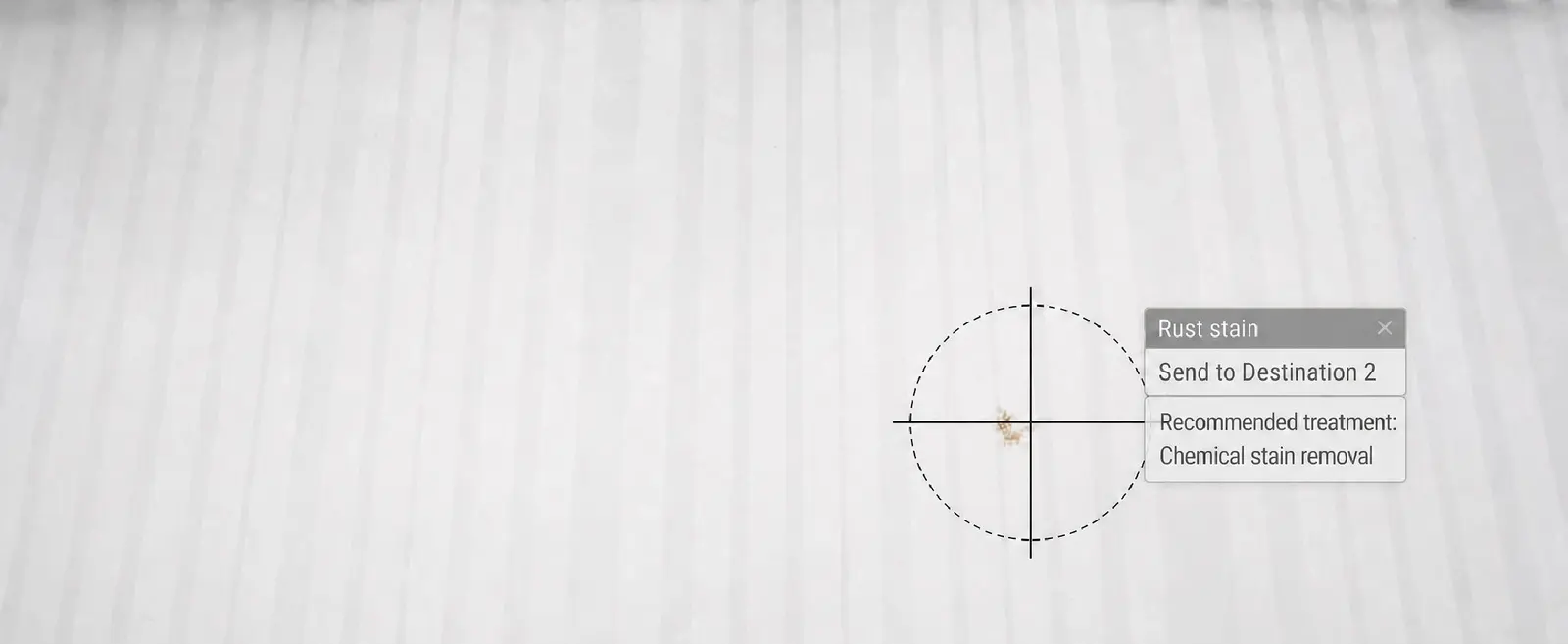
On towel folders, two different camera types work at the same time. The system combines their image data for the AI analysis. A screen on the folder shows operators the live view, counts and settings.
You decide how strict the system is. Per defect type, you set:
Borderline pieces are recorded as near-misses for review instead of being rejected. You can run different programmes per product type.
Add RFID antennas and the frame becomes a read zone, on ironer lines and towel folders alike. The system matches each tag read to the inspection of that piece.
Connect your tag data and every defect traces back to the item and its customer. You get a defect and reject history per item, per customer and per article type. You see which pieces fail again and again, and when to take them out of circulation. You also see which customer's linen comes back with the most stains.
You do not need a new ironer line. S.threadscan works with any make and model of folder, with 1, 2 or 4 lanes. It suits ironer lines from 3 m wide and keeps up with lines running at 65 m/min and more. Installation needs power, a network connection and a simple reject-signal connection to the folder.
Maintenance is minimal. You wipe the camera lens once a month. Software and AI models update remotely, so updates need no site visit.
Every detection lands in one console. You filter by defect type, facility, machine and date, and see each image with its confidence score and timestamp.
The system learns from your linen. Operators flag false calls and confirm real defects. Confirmed examples go back into training, and improved models install on the unit remotely. You can also train it to ignore your logos, embroidery and coloured borders, or to detect poorly ironed pieces.
S.threadscan also measures the line itself:
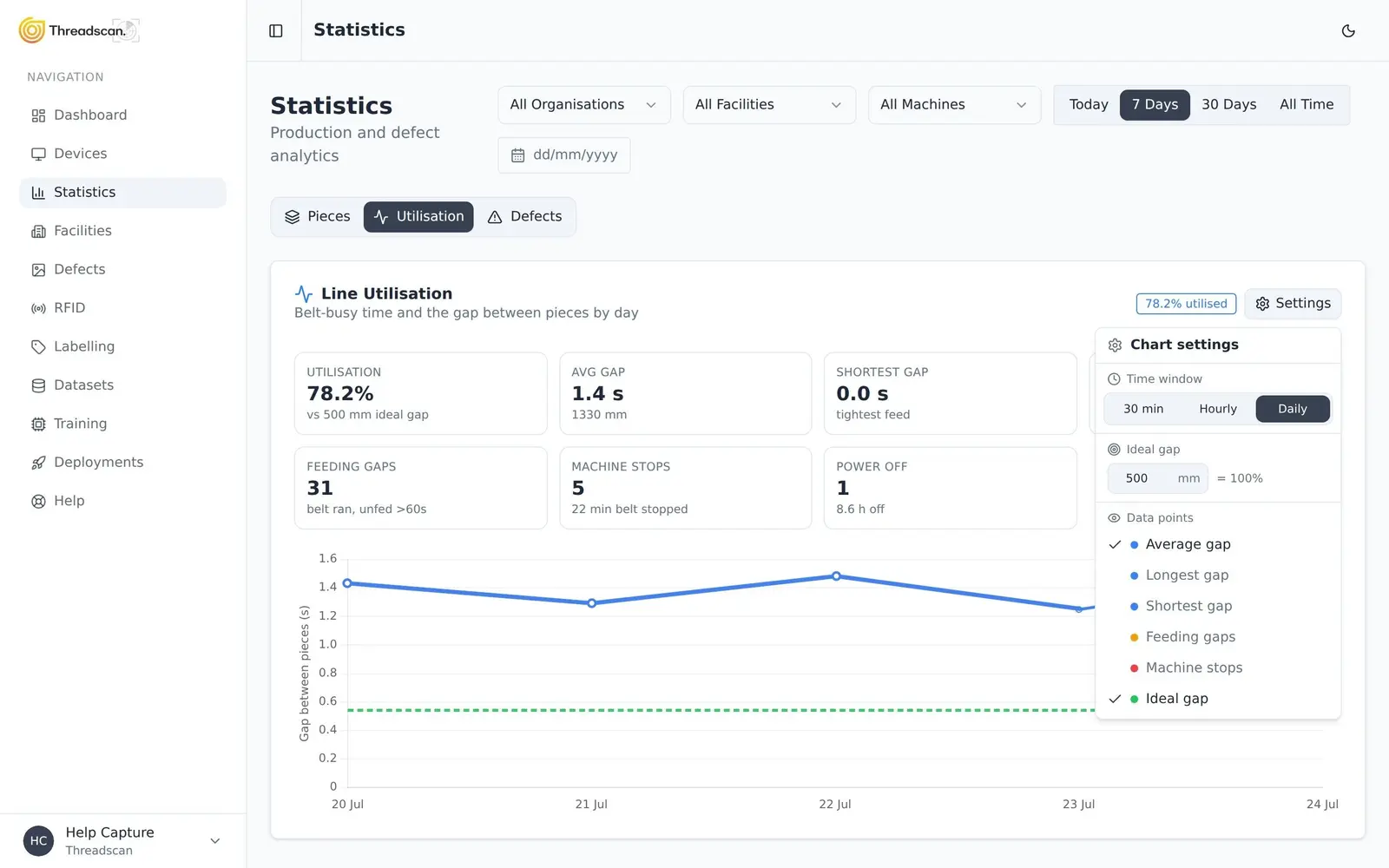
You compare machines, shifts and sites on the same numbers, on any device or a wall screen. An API sends detections, production data and RFID reads to your laundry management system or ERP.
The defect record also gives you objective evidence of wash quality. If rewash rises, you can show your chemical supplier the data.
EU customers' data stays on servers in the EU. The inspection itself runs on the unit.
S.threadscan already runs in production in many laundries. At one large linen laundry, a single unit on the main sheet line delivered these results:
With a unit on both of its sheet lines, the laundry expects customer rejects to fall by almost half.
CLMTexfinity presented S.threadscan to European laundries at EXPOdetergo International 2026 in Milan. We handle sales, installation and support in Europe.
A version of S.threadscan for garment finishing lines is in development, with release planned for early 2027.
Want to see S.threadscan on your own line? Contact CLMTexfinity at info@clmtexfinity.com.